

Guide: Choosing an Electric Hoist
This article will help you choose the right Electric Hoist for your task. We hope you find it useful and remember, if you have any questions, our team is on hand to answer any questions you may have about electric chain parts.
Points to consider when choosing an Electric Chain Hoist:
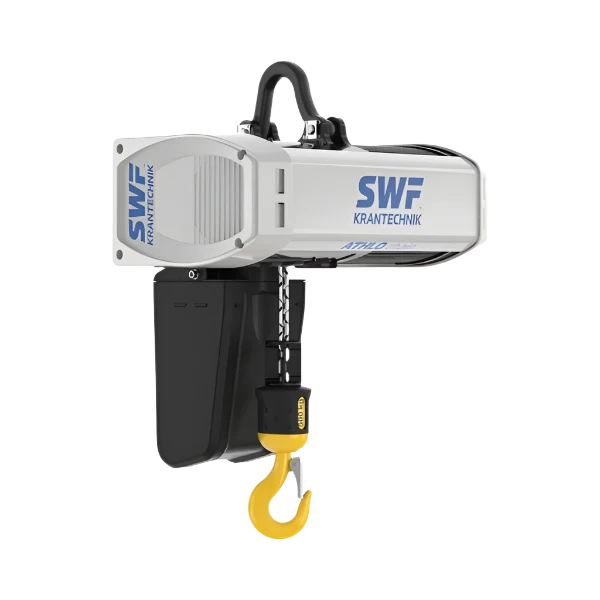
Working Load Limit (WLL) – (Safe working load)
– the maximum weight you want to lift. Some customers would like to have a small margin between the maximum load and the hoist's WLL, which means that they often buy a hoist with a slightly larger lifting capacity. It is not essential, but can be a good idea as it sometimes gives a faster lift speed and a lower impact on the larger motor. Theoretically, this can extend the life of the waist itself. To make it simple, you can work with any model based on the maximum weight you intend to lift – for example 250kg, 500kg, 1000kg, 2000kg etc.
The lifting height
The lifting height is usually measured in meters from the underside of a beam/crane track/hoist housing. It is better to have a lift height that is too long than too short. If a waist is purchased with e.g. 19 meters lifting height and it turns out that 20 meters must be used, then you have to buy a new calibrated lifting chain, which can be expensive
Suspension method
Hanging method generally means the way the waist is hung. It can be from a fixed point such as a top hook with safety pawl or suspension eye, which is bolted to the hoist housing and works perfectly for stationary hoists. If it is required that the waist must be able to be pushed/pulled back and forth on the beam, it is mounted in a manual Trolley, which is adapted to the profile of the beam. The control cable should never be pulled to move the hoist.
Trolleys can also be supplied with electric control with 1 or 2 speeds.
Power supply
Power supply is the type of electricity the hoist uses, so usually the power available on site. In residential areas it is usually 110V or 230V with 1 phase. In industry, most often 400V with 3 phases. If 400V is available, we recommend purchasing a 400V 3-phase hoist as this is cheaper to run, more reliable and available in 2 speeds. So in general you will get more for your money with a 3-phase waist. The vast majority of hoists are supplied as 400V, so remember to be aware of this when ordering.
Chain lengths single or double cut.
A double lifting chain provides maximum stability and reduces fluctuations of the load. However, the hoist will be heavier to work with compared to a single-cut chain hoist and usually has a slower lifting speed (which is desirable in some cases) since the hoist housing is larger than on a single-cut hoist. The lifting chain is the same on both types of hoists. On the single-cut, the hook sits directly in the chain, whereas the chain on double-cut waists is pulled over a sprocket so that it goes down twice into the hook block.
A hoist where the load hook is mounted directly on the chain can work faster and can often be changed to run with a double chain to increase lifting capacity and reduce speed, but this can be an expensive upgrade.
Engine power
One thing that should be considered is how often you want to use the hoist, how many times an hour, etc. Will there be lifts where the entire chain is run out or only small lifts. This information will help you choose the right waist. Although it may sound confusing, it is a question of whether the waist is used often, where the engine is heavily loaded with the risk of overheating. It is not a problem if the hoist is used under normal circumstances as all our hoists are of high quality and have at least 25% excess capacity in normal use. Our team can point you in the direction of hoists with a larger motor capacity or with overheat protection which simply shuts off the motor if the motor heat rises to a certain point (this should only be used as a safety factor – not a guideline).
Single or double speed.
Most ideal is double speed, as you get a slow (creeping) speed or a fast (normal) speed. However, 1-phase units will only have one speed, which is a disadvantage of 1-phase hoists. Units with 3 phases usually have double speed in both waist and trolley (if this is electric), which provides ideal smooth and precise movements.
